
Avery Rowe
New member
- Joined
- Jun 6, 2026
- Messages
- 1
- Points
- 0
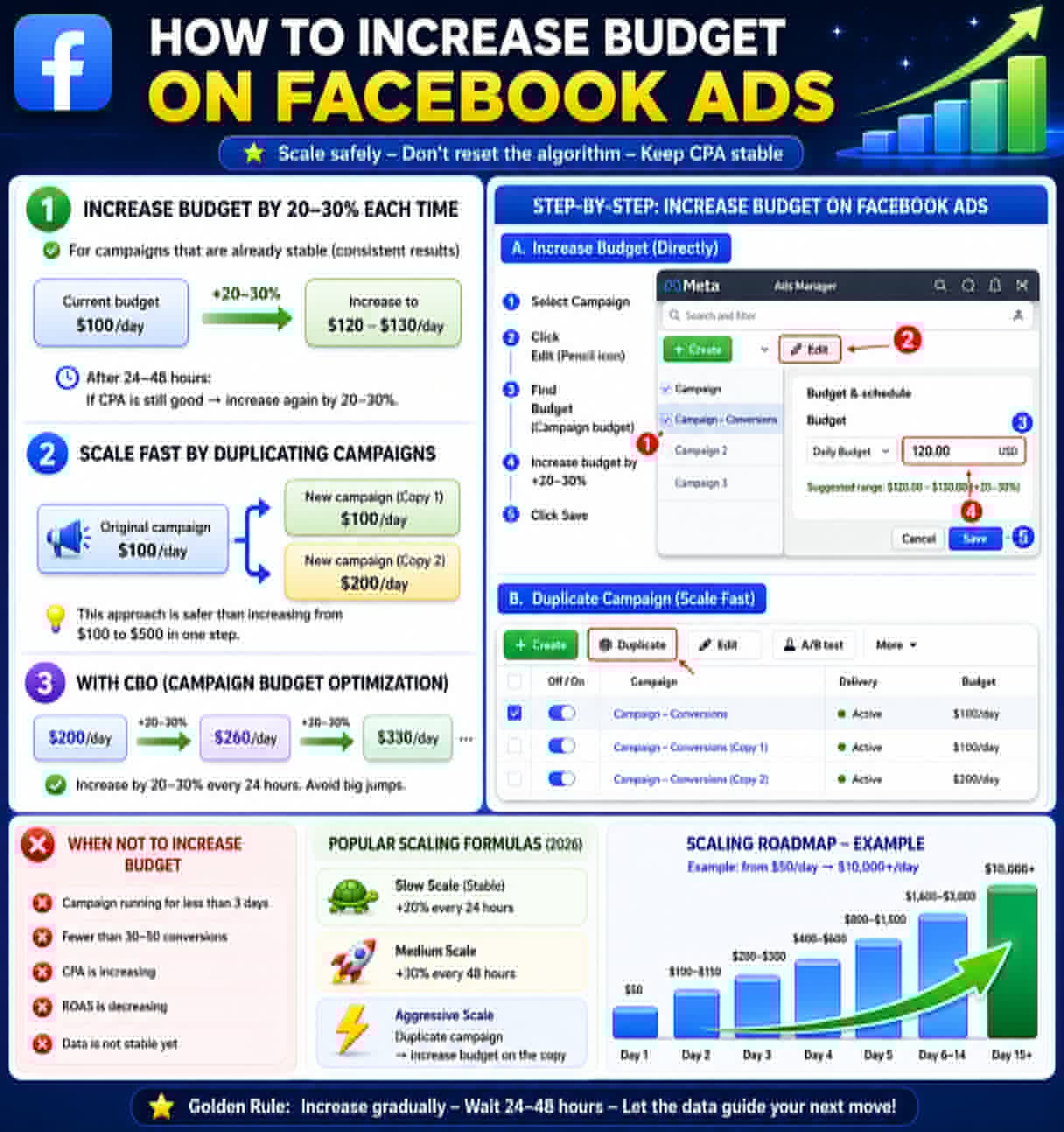
The most common answer is: “Increase the budget by 20%-30% at a time, don’t increase it too quickly.”
That’s not wrong. But it’s not enough.
Because there are times when you can absolutely scale much more aggressively—faster than that. The problem is that most people don’t know when it’s okay to do that.
The real question isn’t “how much percentage increase?”
The correct question is: how much can you increase spending without ruining your margin?
-----------------------------
Scale usually means reaching a wider, colder audience. CPA will increase. ROAS will decrease. Excess budget will flow to poor clients, poor placement, and ineffective creatives.
That’s why scaling isn’t about “just adding money”—it’s about knowing your limits before the numbers spiral out of control.
-----------------------------
3 signs that your campaign is ready for aggressive scaling:
1. You understand your unit economics.
This is the foundation of every scaling decision. You need to know: at what ROAS can you still make a profit? And does that number take into account the customer's LTV, or just look at the first order?
A brand running a subscription model might accept an ROAS of 1.2x on the first purchase — because backend revenue from subsequent months is where they actually make money. While another brand needs an ROAS of 3x right from the start to break even.
The same number, two completely different pictures.
Furthermore: the ROAS that Facebook or Google report to you is often lower than the actual figure — because the platform's attribution doesn't account for all cross-channels. If you only look at the platform's dashboard without using independent measurement tools, you're making decisions based on incomplete data.
2. When spending increases, performance doesn't collapse
This is the clearest signal. You increase your budget, purchases increase accordingly, and ROAS remains the same or doesn't decrease too much — that's a sign the campaign has room to scale.
Conversely, if you increase your budget by 20% and your ROAS immediately drops by 40% — that campaign has reached its ceiling, and you shouldn't push it further.
The way to track this is to look at daily performance after each spending increase, not weekly or monthly. When you scale quickly, the market responds very quickly — and you need to be sensitive enough to recognize it early.
3. Your Funnel Matches Your Audience
This is what determines how high your scaling ceiling can be.
When the creative is at the right angle, the landing page is targeting the right people, and the entire funnel speaks the same language as that audience — then increasing spending simply means reaching more people within that same pocket. The campaign continues to work for the right reason, not by luck.
But if the funnel isn't tight — the creative says one thing, the landing page says another, the product page says a third — then no matter how much money you pour in, you're only amplifying that confusion.
The formula for raising the scale ceiling: continuously test creatives to find winners, split by device and audience to understand what's working, and build separate landing pages for each angle instead of using a single page for everything.
-----------------------------
In short
The advice to “increase by 20%-30% each time” still holds true for most cases — it's safe and low-risk.
But if you have all three things above: understanding unit economics, a campaign that maintains performance while increasing spend, and a funnel that aligns with the audience — then you can push much more aggressively than what is “recommended.”
Scale isn't about bravery or recklessness. It's about whether you have enough data to be confident.
That’s not wrong. But it’s not enough.
Because there are times when you can absolutely scale much more aggressively—faster than that. The problem is that most people don’t know when it’s okay to do that.
The real question isn’t “how much percentage increase?”
The correct question is: how much can you increase spending without ruining your margin?
-----------------------------
Scale usually means reaching a wider, colder audience. CPA will increase. ROAS will decrease. Excess budget will flow to poor clients, poor placement, and ineffective creatives.
That’s why scaling isn’t about “just adding money”—it’s about knowing your limits before the numbers spiral out of control.
-----------------------------
3 signs that your campaign is ready for aggressive scaling:
1. You understand your unit economics.
This is the foundation of every scaling decision. You need to know: at what ROAS can you still make a profit? And does that number take into account the customer's LTV, or just look at the first order?
A brand running a subscription model might accept an ROAS of 1.2x on the first purchase — because backend revenue from subsequent months is where they actually make money. While another brand needs an ROAS of 3x right from the start to break even.
The same number, two completely different pictures.
Furthermore: the ROAS that Facebook or Google report to you is often lower than the actual figure — because the platform's attribution doesn't account for all cross-channels. If you only look at the platform's dashboard without using independent measurement tools, you're making decisions based on incomplete data.
2. When spending increases, performance doesn't collapse
This is the clearest signal. You increase your budget, purchases increase accordingly, and ROAS remains the same or doesn't decrease too much — that's a sign the campaign has room to scale.
Conversely, if you increase your budget by 20% and your ROAS immediately drops by 40% — that campaign has reached its ceiling, and you shouldn't push it further.
The way to track this is to look at daily performance after each spending increase, not weekly or monthly. When you scale quickly, the market responds very quickly — and you need to be sensitive enough to recognize it early.
3. Your Funnel Matches Your Audience
This is what determines how high your scaling ceiling can be.
When the creative is at the right angle, the landing page is targeting the right people, and the entire funnel speaks the same language as that audience — then increasing spending simply means reaching more people within that same pocket. The campaign continues to work for the right reason, not by luck.
But if the funnel isn't tight — the creative says one thing, the landing page says another, the product page says a third — then no matter how much money you pour in, you're only amplifying that confusion.
The formula for raising the scale ceiling: continuously test creatives to find winners, split by device and audience to understand what's working, and build separate landing pages for each angle instead of using a single page for everything.
-----------------------------
In short
The advice to “increase by 20%-30% each time” still holds true for most cases — it's safe and low-risk.
But if you have all three things above: understanding unit economics, a campaign that maintains performance while increasing spend, and a funnel that aligns with the audience — then you can push much more aggressively than what is “recommended.”
Scale isn't about bravery or recklessness. It's about whether you have enough data to be confident.